Avoid AI-SEO / GEO Services Traps In Malaysia
AI-SEO Challenges In Malaysia
Executive Summary For Malaysia AI-SEO Challenges
-
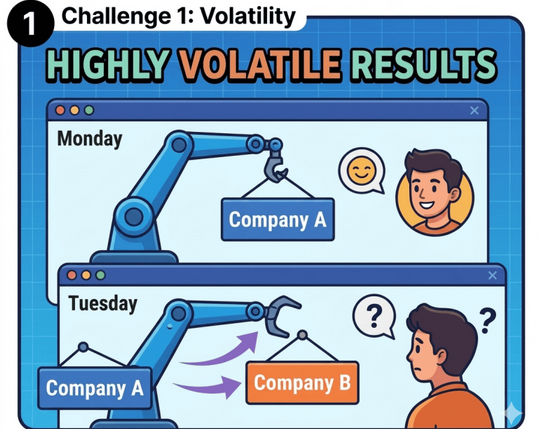
Extreme Volatility: Unlike stable Google rankings, AI answers change constantly—a brand featured today can easily be omitted tomorrow for the exact same prompt.
-
Hyper-Personalization: There is no standard “Top 10” ranking list; AI customizes every answer based on individual user data (history, location, demographics).
-
Zero Search Volume Analytics: As of June 2026, no tools exist to track query volumes inside ChatGPT or Gemini, meaning agencies are completely guessing which prompts are worth targeting.
-
The Zero-Click Dilemma: Citations rarely convert to traffic because users get answers directly on the platform. Click rates are notoriously low—averaging just 6%–11% on ChatGPT and a mere 1% on Google Gemini.
Introduction
In Malaysia, there is increasing number of SEO providers offering new “AI search optimization”. They might be dressed in different buzzwords like AEO (Answer Engine Optimization), GEO (Generative Engine Optimization), AI-SEO or LLMO (Large Language Model Optimization).
Whatever technical term they use above, the goal is the same: optimize your website and get it cited and featured by AI engines such as ChatGPT, Google Google’s AI Overviews, Gemini or Microsoft Copilot.
But there are some traps to get a website cited / appear on AI engines that most of the SEO providers won’t tell you.
Thinking of investing in AI-SEO / GEO / AEO in Malaysia (whatever you name it), you need to know these 4 critical challenges :
1. AI Engine Answers are Highly Volatile and Constantly Changing
Unlike the relatively fixed Google search results from day to day, the answers from AI engines are constantly fluctuate. If you enter the same exact prompt (keyword phrase) on different days, the AI engine will probably give you totally different results.
For example, if you are to search for “best furniture supplier in Malaysia” today, Company A may appear. But tomorrow the AI might reproduce a new response, and leave company A out entirely. That’s what “generative” means—the algorithm is creating data on the fly, based on shifting preferences in real time, so it’s incredibly hard to keep things consistently visible.
2. Hyper-Personalized Answers On Al Engines
AI engines don’t give a one-size-fits-all answer to every user. Instead, They will give different answer for different people – Because each people’s context is different (like prompt history, device, location etc).
For instance, a young lady looking for the “best car in Malaysia” will likely get a totally different set of AI answer than a senior citizen searching for the same phrase. Because the AI customizes the answer to fit the user’s assumed age, gender, lifestyle and past prompts.
3. No Keyword Search Volume Analytics for AI Engines
If you have experience with Google Ads then you probably know about Google Keyword Planner. This is a handy SEO tool for digital marketers, offering precise metrics on keyword search volume and historical performance. It helps companies to filter out unrealistic search keywords and concentrate on valuable target.
Let’s take this example of comparing two different search queries:
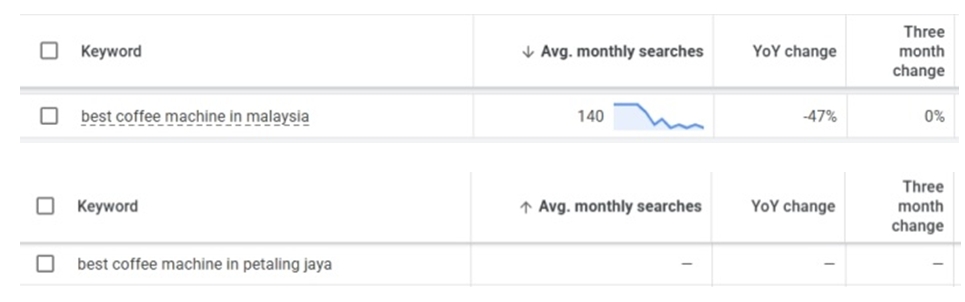
The choice is obvious to a smart businessman. You would target “best coffee machine in Malaysia” because it has active, measurable demand (140 searches per month) in Google Keywords Planner, while the “best coffee machine in Petaling Jaya” keyword has zero search demand per month.
So back to AI engines optimization. The AI engines don’t show you the statistic of the keywords (prompts) like what you see above in Keywords Planner. Platforms like ChatGPT, Gemini and Copilot do not publish prompt search volumes and user query frequencies. This is a critical blind spot for businesses: how do you validate which prompts are worth optimizing for?
When an AI-SEO / GEO / AEO agency Malaysia approaches you with his AI search optimization package and promises to get your brand mentioned for a phrase like “Best [Your Industry] Company in Kuala Lumpur”, you must challenge them with two fundamental questions:
“How did you verify this particular prompt is worth targeting?” • “What is the monthly search volume for this exact query?”
I bet you can’t get a statifying answer from this SEO agency. Because at this point in time, June 2026, there’s simply no software or native tool on the market that tracks query volume inside of Copilot, Gemini or ChatGPT. Any agency claiming to have these exact numbers is guessing at best – and this is gambling with your marketing budget on unverified assumptions.
4. AI citations do not mean traffic (The Zero-Click Dilemma)
Even if an SEO agency Malaysia can successfully get your website cited by AI engines, it does not automatically translate into website traffic. Think about your own user behavior: when you ask ChatGPT or Gemini a question, how often do you actually click on the hyperlinked sources to read further? For most users it’s probably 1 or 2 out of 10.
This is what we call “Zero-Click Searches” in the SEO industry. The AI synthesizes and gives the final answer right on their result, so the user gets exactly what they need and has no intention to click through to your site. However, according to the study from Search Engine Journal, only average 6%-11% of people will click the citation in ChatGPT and 1 % of people will click the citation in Google Gemini.
The Conclusion
If you are paying RM 24,000 to RM 48,000 Ringgit a year for a standalone AI-SEO / GEO / AEO package from an SEO agency in Malaysia, you are facing two huge risks: either your website won’t get cited consistently because of the volatility of the AI Engines algorithm, or you will get cited but see no growth in actual website traffic whatsoever.
To get reliable AI-SEO services Malaysia, please visit Maximus website at : https://webdesign.maximus.com.my/what-ai-seo-agency-malaysia-wont-tell-you-about-ai-optimization/
